
Frequently Asked Questions
What is the Relationship between Habitat for Humanity International and the local affiliate?
Is there a religious requirement for the Habitat program?
Are Habitat homes free housing?
Who is eligible for a Habitat Home?
What is required of a Habitat Homeowner?
How does Habitat make payments affordable
What can I do if my credit score is below 640?
How long does the Homeownership process take?
Why is homeownership so important?
Who is eligible for the Priority Home Repair program?
How does the Priority Home Repair Program Work?
What is the Relationship between Habitat for Humanity International and the local affiliate?
Habitat for Humanity – Grand Traverse Region is an independent, nonprofit organization; every donation made to our local affiliate stays in our community to serve the people of Grand Traverse, Kalkaska and Leelanau Counties. We are an affiliate of Habitat International and associated with Habitat Michigan.
The national and Michigan habitat organizations are resources. Habitat-GTR works with these national and state organizations for educational programing, training programs, brand support, and to identify sources for donated building materials.
Our office and ReStore are in Traverse City.

Is there a religious requirement for the Habitat program?
 Habitat builds houses with anyone who meets our criteria - regardless of race, religion or any other difference. Although Habitat for Humanity is an ecumenical Christian organization, without affiliation to any denomination, we believe that God’s love extends to everyone. There is no religious, cultural, racial or any other criteria that divide potential Habitat homeowners.
Our volunteers and homeowners come from the entire local community. We welcome and embrace partners and volunteers from any faith, as well as those who have no religious faith. We observe all Fair Housing guidelines.
Are Habitat homes free housing?
The Habitat homeownership program is a hand up, not a hand out. It isn’t easy to become a Habitat homeowner. The commitment and hard work of Habitat homeowners make them ideal neighbors and community members.
- They have jobs with a 1 year or longer history of employment.
- They have good credit with no defaults or delinquent payments.
- They have minimal debt.
- Each adult completes a minimum of 200 hours of sweat equity.
- They take financial management and homeownership classes.
At some time in their history, Habitat homeowners may have lived in government-subsidized rental housing. The habitat homeownership opportunity breaks the cycle of dependency and creates stability and self-reliance.
In order to preserve the value of other neighborhood properties, Habitat sells the home to the homeowner at market rate. Habitat homeowners apply for a mortgage with payments that are 30% of their gross income. When a payment of 30% of their gross income will not fully cover the cost of the home, Habitat Grand Traverse Region assumes the portion of the mortgage that exceeds what the homeowner can afford. This is called a silent second mortgage, and is only paid back when and if the homeowner sells the home within the mortgage period.
Habitat Homeowners have a real sense of ownership for both their homes and their new neighborhoods.

Habitat homeowner, Cori and Jesse working on a home for another Habitat homeowner Hayley.
Who is eligible for a Habitat Home?
There are a few basic requirements to be considered for Habitat homeownership:
- Gross household income between 50% and 80% of Area Median Income.
- Steady employment for at least 12 months.
- A credit score of 640 or higher.
- Household debt under 10% of gross income.
- Willingness to partner with Habitat.
- Demonstrates this desire through completing application in a timely manner, participating in sweat equity, and fulfilling all requirements.
- Demonstrated need.
What is required of a Habitat Homeowner?
Habitat homeowners work hard to buy their homes with an affordable mortgage. An affordable mortgage has a monthly payment, including property tax and homeowner’s insurance, of 30% or less of their household gross income. To be eligible for these special mortgage opportunities, homeowners must:
- Show financial stability by:
- Providing evidence of 1 year of steady income from employment, Social Security, self employment, or other income forms.
- Having a credit score of 640 or higher with no charge offs, collections or bankruptcies more recent than 3 years.
- Total household debt that is 11% or less of their gross income.
- Show responsible spending habits.
- Take classes in Financial Management, Budgeting, and Home Maintenance.
Habitat also requires homeowners to do the following:
-
- Each adult (18 and older) in the household must complete 200 sweat equity hours.
- Must save $1,000 toward their home’s down payment.
How does Habitat make payments affordable?
Habitat for Humanity uses several tools to make payments affordable. These tools are used to assure the partner’s mortgage payment, with property tax and homeowner’s insurance is not more than 30% of their income at the time of closing. Mortgage loans are originated through USDA and other low interest loan programs. Loan terms are extended up to 33 years to assure the payments are affordable. Homeowners are also income qualified for down payment assistance through MSHDA.
In some cases, Habitat will fund part of the purchase with a silent second mortgage. If the homeowner sells the home, the second mortgage is paid back to Habitat from the sales proceeds.
What is sweat equity?
Each adult in a Habitat for Humanity – Grand Traverse Region families contributes 200 hours of sweat equity. Sweat Equity hours are recorded and include a combination of education, the construction of their home or other Habitat projects, and qualified volunteer opportunities. Family and friends are able to assist the homebuyer by completing 40 of the 200 hours on their behalf.
Sweat equity is a cornerstone of the Habitat ministry designed to meet three important goals:
- Partnership – meaningful interaction between partner families, affiliate representatives and Habitat volunteers.
- Pride in homeownership – Investing in sweat equity hours in their own homes helps families begin the transition to homeownership.
- Development of skills and knowledge.
In the classroom families participate in Home Maintenance classes to equip them with basic skills they will use in their home in the future. Classes in Financial Management, Budgeting, Use of Credit, etc. help the family understand what they need to do once they own their home to be able to maintain their home long-term. On the build site, partner family members gain a real understanding of the construction of their home and of the maintenance issues they will face during occupancy.

Habitat Homeowner Candace completing some of her sweat equity volunteering at the Traverse City ReStore.
What can I do if my credit score is below 640?
We are available to help anyone work to rehabilitate their credit, even those not currently eligible for our programs. Habitat for Humanity Grand Traverse Region partners with Habitat for Humanity Michigan to offer free classes, financial coaching, and other tools to help interested applicants work to get their financial situation in order and build their credit score. While individuals or families with low credit scores cannot immediately apply for Habitat programs, they can become eligible after they have established good credit.
How long does the Homeownership process take?
The application process itself can take two or more months depending on how promptly applicants can supply documentation and other materials required as part of the process.
Once an applicant is accepted into the program, the actual home build through closing usually takes 8 to 12 months. This timeline gives ample time for homeowners to complete their sweat equity hours. This means that, from application to closing, a homeowner is in the program for approximately 10-18 months. The average is 12 months.
We can never guarantee a specific time because of the numerous uncontrollable factors involved in the building process, from weather and permitting to availability of building materials and subcontractors.
Why is homeownership so important?
The quality of housing has major implications on health. A home with mold, rodents and pests can trigger or cause chronic respiratory conditions, including asthma. Overcrowded or substandard housing poses a risk to the health and physical well-being of families and their neighbors, and facilitates the spread of infectious diseases. This is especially true when families are required to shelter at home for long periods of time.
A safe, decent, affordable place to live can make a real difference in the life of a family. Homeownership has long been the primary way for families to build wealth. Homeownership also offers stability because monthly mortgage payments are predictable whereas rents can increase year over year.
A stable home is important for academic achievement. Children who change schools as their families move in search of more affordable housing can struggle to keep up academically. Studies have shown, even when adjusting for all other variables, children raised in a home owned by their parents perform better in school than their peers living in rental housing.
Homeowners enjoy stability and self-reliance. Homeownership leads to strong healthy families. This is why we build.
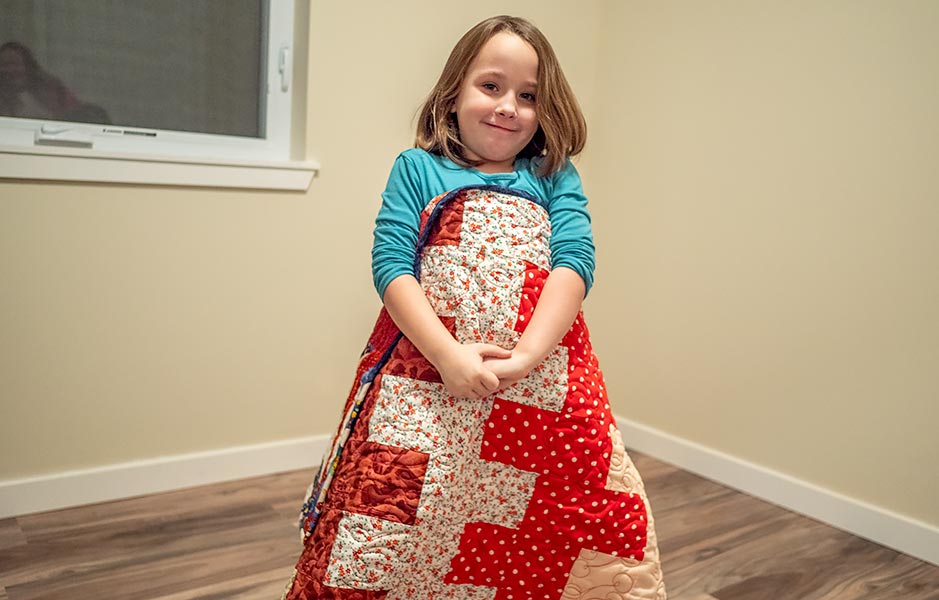
Amenia, at the family's Habitat home dedication, excited to have her own bedroom.
Who is eligible for the Priority Home Repair program?
Habitat Priority Home Repairs are available to homeowners in Grand Traverse, Kalkaska, and Leelanau Counties with household incomes that fall within 30%-60% of the area median income (AMI) based on household size. Repair recipients must need a critical repair and own their home, own the land their home is on, and be up to date on mortgage payments, homeowner’s insurance, and property taxes.
To be eligible each adult (18 and older) in the household must take 10 hours of financial education. Applicants must also complete and return all application materials in a timely manner.
How does the Priority Home Repair Program Work?
The Habitat for Humanity Grand Traverse Region Priority Home Repair program works with homeowners to correct issues with a home impacting health, basic livability, safety, and access. Once eligibility is determined, a Habitat representative will perform a home evaluation to prioritize needed repairs.
Repairs may be completed by Habitat GTR staff, Habitat volunteers, or qualified subcontractors coordinated by Habitat.
All repair recipients must pay back a portion of their repair costs. The payback amount is the total repair cost multiplied by the homeowner’s percentage of AMI. The homeowner’s balance has a 60 month pay-back period at 0% interest, and there will be a lien on the home until the balance is paid.
If recipient sells the home within the payback period, they will pay the outstanding balance in one lump sum from the sale proceeds.
What repairs are eligible for the PHR program?
We make repairs that are necessary for safety, health, or accessibility. These include, but are not limited to, roof repair or replacement, windows, heating and cooling issues, accessibility (ramps, grab bars, etc.), electrical problems, water leaks or water damage, bathrooms, siding, gutters, and tree removal, if a danger to safety.
The Habitat for Humanity Priority Home Repair Program Does Not perform repairs for solely cosmetic purposes.
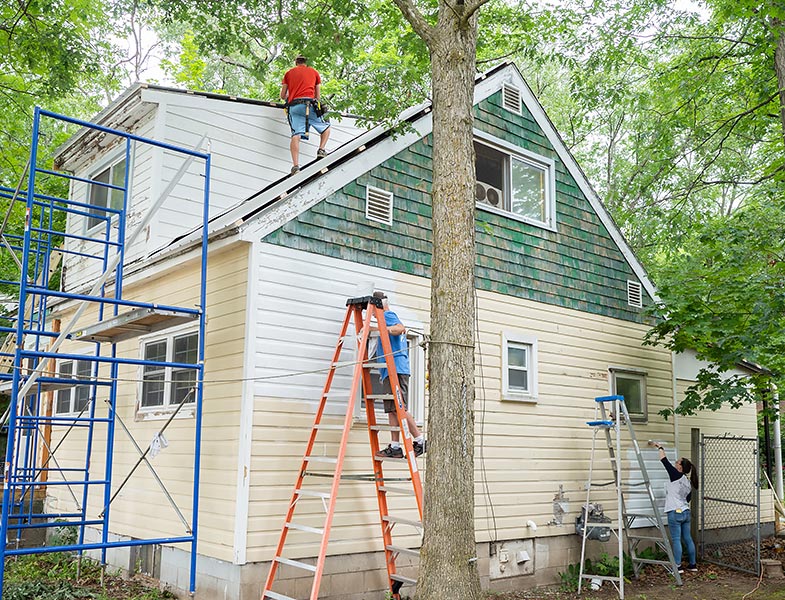
Habitat Volunteers rehabilitating an aging home in Traverse City. Critical home repairs keep existing homes safe and healthy, reducing the need for additional housing stock.
How can someone apply?
Both Homeownership and Priority Home Repair partners begin the Habitat process by completing a the short Step 1 Application snapshot. The applications are available for download below or can be picked up at our Restore.
Habitat ReStore
2487 Rice Street
Traverse City 49684